Building AI applications has never been more exciting or more demanding. Whether you’re training large language models, generating images, running inference, or experimenting with machine learning, one thing quickly becomes clear: powerful GPU resources are essential. The challenge is finding cloud infrastructure that delivers high performance without locking you into complicated pricing or enterprise-level contracts. That’s where Runpod steps in. Its Cloud GPUs platform is designed for developers, researchers, startups, and businesses that want flexible access to high-performance GPUs without unnecessary complexity. Instead of spending time managing infrastructure, users can focus on building, testing, and deploying AI projects faster.
Why Runpod Cloud GPUs Stand Out in a Crowded Market
The biggest strength of Runpod Cloud GPUs is flexibility. Rather than forcing users into rigid infrastructure plans, Runpod allows developers to launch GPU instances on demand, making it easy to scale resources according to project requirements. Whether you’re experimenting with a personal AI project or deploying production workloads, the platform offers a wide selection of GPU options that match different performance needs and budgets. This flexibility helps reduce wasted resources because you’re only paying for the computing power you actually use. The straightforward interface also lowers the learning curve, making cloud GPU deployment far more approachable than many traditional cloud platforms.
Built for AI Development From Day One
Unlike general-purpose cloud providers that support countless workloads, Runpod focuses heavily on AI and machine learning. That specialization becomes obvious as soon as you begin using the platform. Popular AI frameworks integrate smoothly, allowing developers to launch environments optimized for deep learning, generative AI, computer vision, and natural language processing. Whether you’re fine-tuning open-source language models, training custom neural networks, or running Stable Diffusion image generation, Runpod provides infrastructure specifically designed for GPU-intensive tasks. This dedicated approach reduces setup time and allows developers to spend more time improving models rather than configuring servers.
A Wide Range of GPU Choices for Every Project
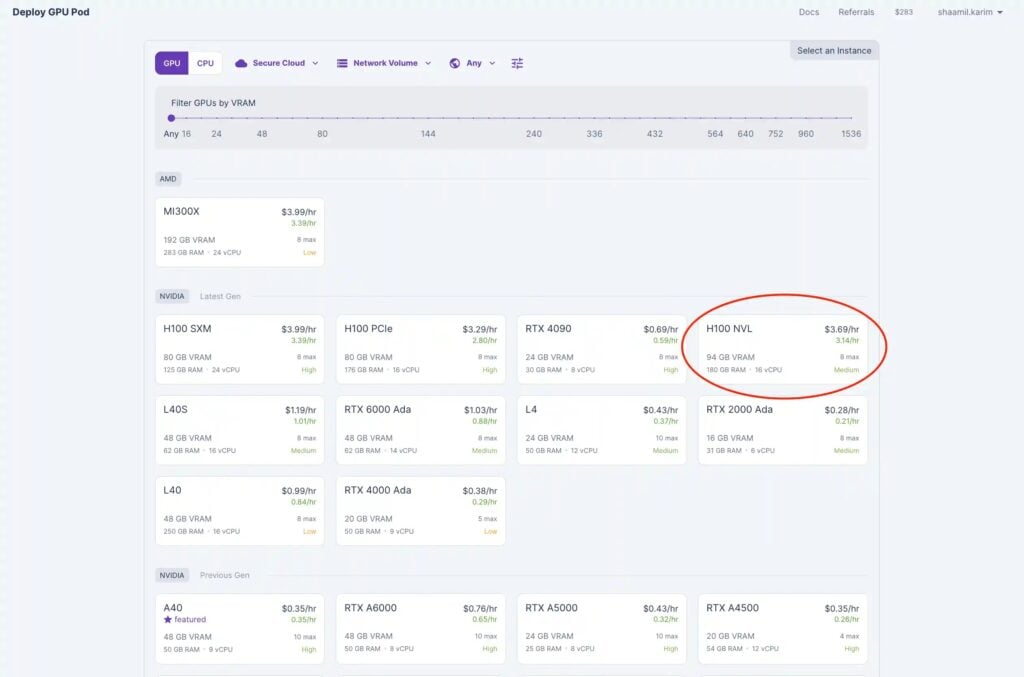
Every AI workload has different hardware requirements, and Runpod recognizes that reality. Instead of offering a limited selection of GPU configurations, the platform provides access to multiple GPU generations suitable for everything from lightweight inference tasks to demanding model training. Smaller projects can start with cost-effective GPUs, while enterprise-scale workloads can take advantage of significantly more powerful hardware. This variety means users don’t need to overpay for resources they won’t fully utilize. As projects grow, Runpod makes scaling straightforward, allowing teams to upgrade infrastructure without rebuilding their entire workflow.
Speed Matters When Building AI Applications
Time is often one of the most valuable resources for AI developers. Waiting hours to provision infrastructure or configure environments slows innovation. Runpod minimizes those delays by offering rapid deployment of cloud GPU instances. Developers can launch environments quickly and begin running workloads within minutes rather than navigating lengthy infrastructure setup processes. Fast provisioning is especially valuable during experimentation, where multiple training runs, model comparisons, and testing cycles happen continuously. The quicker developers can access GPUs, the faster they can iterate, identify improvements, and move projects toward production.
Transparent Pricing That Supports Growing Teams
One concern many organizations have when moving AI workloads to the cloud is unpredictable cost. GPU resources can become expensive if pricing models are difficult to understand or if infrastructure remains active unnecessarily. Runpod addresses this challenge by offering transparent, usage-based pricing that gives users more control over spending. Startups can begin with smaller deployments while established companies can scale larger workloads as demand increases. This flexibility allows teams to balance performance with budget rather than committing to oversized infrastructure from the beginning. The result is a cloud platform that feels accessible to independent developers while remaining capable enough for professional AI operations.
Who Benefits Most from Runpod Cloud GPUs?
The versatility of Runpod makes it appealing across multiple industries and experience levels. Independent developers can experiment with AI models without investing in expensive local hardware. Research teams benefit from scalable GPU access for computationally intensive projects. AI startups gain production-ready infrastructure that grows alongside their products, while larger businesses can accelerate machine learning initiatives without managing complex on-premise GPU clusters. Even content creators working with generative AI tools can leverage Runpod to handle demanding rendering and inference workloads more efficiently. This broad usability explains why the platform continues attracting users from across the AI ecosystem.
A Smarter Way to Power Modern AI Workloads
The rapid growth of artificial intelligence has created enormous demand for reliable, scalable GPU computing, and Runpod Cloud GPUs rises to that challenge with an approach that prioritizes simplicity, flexibility, and performance. Instead of overwhelming users with unnecessary infrastructure complexity, Runpod delivers the computing power needed for today’s AI applications through an accessible platform built around real developer workflows. Whether you’re training your first machine learning model, deploying production inference, experimenting with generative AI, or scaling enterprise workloads, Runpod provides the tools and GPU resources to keep projects moving efficiently. For developers seeking cloud GPUs that combine ease of use with serious computing capability, Runpod offers a compelling solution that grows alongside every stage of AI development.